
Industrial piping systems operate under continuously changing conditions. Temperature variations, equipment vibration, pressure fluctuations, and mechanical movements can create stress within piping connections and connected equipment.
To manage these challenges, industries use flexible components such as rubber expansion joint bellows. These components are designed to accommodate specified movement, reduce vibration transmission, and provide flexibility between connected piping sections.
For industries such as power generation, water treatment, chemical processing, food processing, pulp and paper, and other industrial applications, selecting the correct rubber bellows expansion joint requires understanding operating conditions, movement requirements, pressure, temperature, media compatibility, and installation conditions.
What Are Rubber Expansion Joint Bellows?
A rubber expansion joint bellows is a flexible piping component manufactured using suitable elastomeric materials and designed to accommodate movement between connected piping systems.
The bellows section provides flexibility, allowing the expansion joint to absorb specific types of movement while maintaining a connection between piping components.
Rubber expansion joint bellows are commonly used to manage:
- Thermal expansion and contraction
- Mechanical movement
- Pipe vibration
- Equipment movement
- Minor misalignment within permitted limits
The actual movement capability depends on the design, material selection, construction, and application requirements.
Why Are Rubber Expansion Joint Bellows Used in Industrial Systems?
Industrial piping systems are exposed to various operating conditions that can create mechanical stress.
Temperature changes can cause pipes to expand and contract, while rotating equipment such as pumps and motors can introduce vibration into connected piping systems.
Rubber expansion joint bellows provide a flexible connection that helps accommodate these operating effects.
Key purposes include:
1. Movement Absorption
Piping systems may experience movement due to thermal changes, equipment operation, or installation conditions.
Rubber bellows expansion joints are designed to accommodate specified movement within their operating limits.
2. Vibration Control
Industrial equipment such as pumps, compressors, and motors can transmit vibration into connected piping.
A flexible rubber expansion joint can help manage vibration-related effects within the piping system.
3. Noise Reduction
Mechanical equipment and fluid movement can contribute to noise transmission through piping systems.
Rubber expansion joints may help reduce the transfer of certain mechanical vibrations.
4. Protection of Connected Equipment
Flexible connections between equipment and piping can help reduce stress caused by movement and vibration.
Types of Rubber Expansion Joint Bellows
Rubber expansion joints are available in different configurations depending on the application.
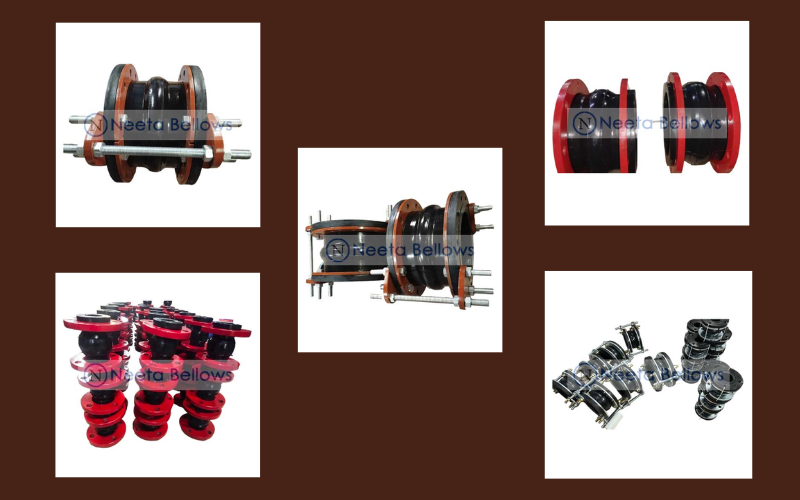
Single Arch Rubber Expansion Joint Bellows
Single arch expansion joints feature one flexible arch section.
They are commonly selected where the required movement, pressure, temperature, and installation conditions are suitable for this configuration.
Selection depends on:
- Pipe size
- Movement requirements
- Pressure rating
- Temperature conditions
- Installation space
Double Arch Rubber Expansion Joint Bellows
Double arch expansion joints incorporate two flexible arch sections.
They may be considered for applications requiring different movement capabilities compared with a single arch design.
The correct selection depends on:
- Required movement
- Piping arrangement
- Operating pressure
- Temperature
- Connection requirements
Rubber Bellows Expansion Joints for Industrial Piping
Industrial piping applications require expansion joints that are compatible with the system conditions.
Important selection parameters include:
- Pipe dimensions
- Fluid characteristics
- Operating pressure
- Operating temperature
- Vibration levels
- Installation arrangement
Applications of Rubber Expansion Joint Bellows
Rubber expansion joint bellows are used across several industries where flexible piping connections are required.
Power Plants
Power generation facilities use extensive piping networks where vibration, thermal movement, and equipment connections require suitable expansion solutions.
Rubber expansion joints can be used in applications where their material construction and operating specifications are appropriate.
Water Treatment Plants
Water treatment systems involve pumps, pipelines, and fluid-handling equipment where vibration and movement management can be important.
Sewage and Wastewater Systems
Wastewater applications may require flexible connections between pumps, pipelines, and processing equipment.
Desalination Plants
Desalination facilities use complex piping systems where movement accommodation and vibration control can be required.
Food Processing Industries
Food processing plants may use piping systems for fluid transfer applications requiring suitable flexible connections.
Pulp and Paper Plants
Large industrial process systems often include piping networks connected to rotating equipment and process machinery.
Key Factors for Selecting Rubber Expansion Joint Bellows
Choosing the correct rubber expansion joint requires evaluating the complete application.
1. Movement Requirements
The first step is identifying the type and amount of movement.
Possible movements include:
- Axial movement
- Lateral movement
- Angular movement
- Equipment vibration
- Mechanical displacement
The movement should be measured wherever possible.
2. Pipe Size and Connection Details
The rubber expansion joint must match the piping arrangement.
Important details include:
- Pipe diameter
- Flange dimensions
- Bolt-hole arrangement
- Face-to-face length
- Installation space
Incorrect dimensions may create installation difficulties.
3. Operating Pressure
Pressure is a critical factor in expansion joint selection.
The manufacturer should receive:
- Normal operating pressure
- Maximum operating pressure
- Pressure fluctuations
The selected rubber bellows expansion joint must be suitable for the system pressure requirements.
4. Temperature Conditions
Temperature affects material selection and expansion joint performance.
Important details include:
- Normal temperature
- Maximum temperature
- Temperature fluctuations
- Exposure duration
For high-temperature applications, suitable construction and materials should be selected.
5. Media Compatibility
The material flowing through the piping system influences rubber selection.
Applications may involve:
- Water
- Air
- Steam
- Chemicals
- Process fluids
- Wastewater
Material compatibility should be confirmed according to the application.
6. Installation Conditions
Available installation space affects expansion joint selection.
Consider:
- Face-to-face dimensions
- Pipe alignment
- Flange position
- Nearby equipment
- Pipe supports
- Maintenance access
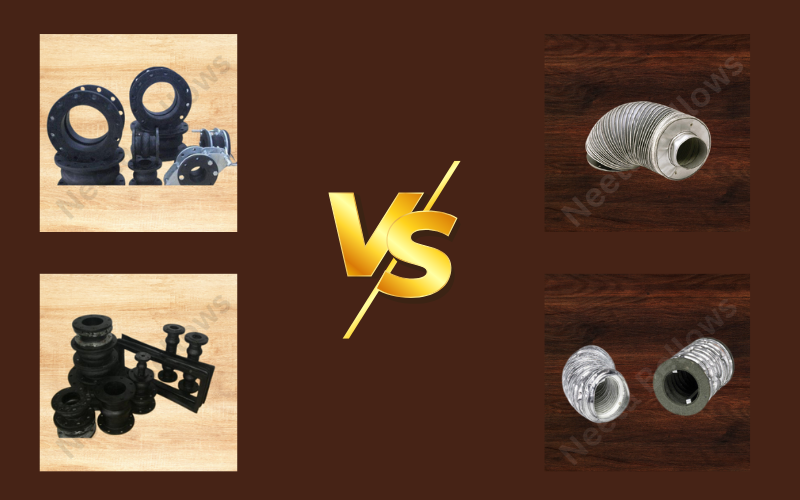
Rubber Expansion Joint Bellows vs Other Expansion Joints
Different expansion joint types are suitable for different operating conditions.
| Type | Common Application Considerations |
|---|---|
| Rubber Expansion Joint Bellows | Vibration control, piping flexibility, equipment connections |
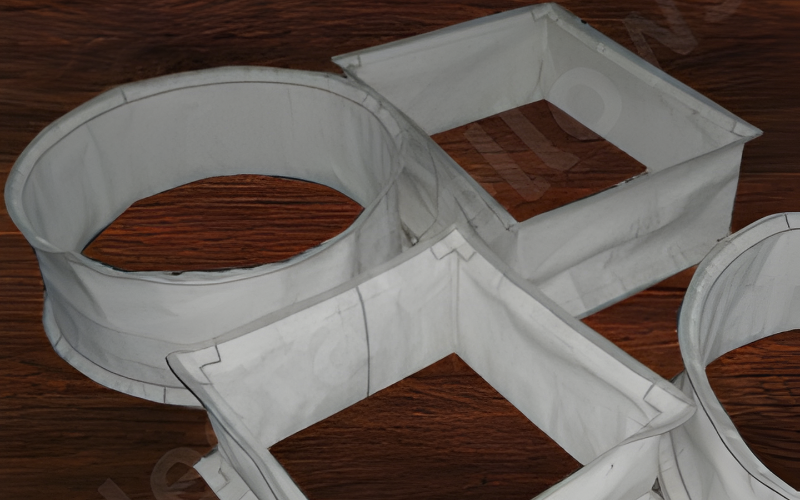
| Fabric Expansion Joints | High-temperature gas and duct applications |
| Metallic Expansion Joints | High-temperature and pressure applications where metallic construction is required |
The correct selection depends on the operating environment and system requirements.
Benefits of Rubber Expansion Joint Bellows
Flexible Piping Connection
Rubber bellows provide flexibility between connected piping components.
Vibration Management
They can be considered for applications where equipment vibration needs to be managed.
Reduced Mechanical Stress
Flexible connections can help accommodate specified movement within the piping system.
Wide Industrial Application Range
Rubber expansion joints are used in multiple industrial sectors depending on application requirements.
Customised Solutions
Industrial piping systems may require customised expansion joint designs based on dimensions, movement, pressure, temperature, and media.
Common Mistakes When Selecting Rubber Expansion Joints
Selecting Only Based on Pipe Size
Pipe size alone does not define the correct expansion joint.
Movement, pressure, temperature, and media must also be considered.
Ignoring Temperature Conditions
Incorrect material selection can affect performance in temperature-sensitive applications.
Not Defining Movement
The manufacturer needs accurate movement information to recommend a suitable design.
Overlooking Installation Space
The available installation length and flange arrangement should be checked before ordering.
Not Sharing Complete Application Details
Providing complete operating information helps manufacturers evaluate the correct solution.
Information Required for Rubber Bellows Expansion Joint Selection
Before contacting a manufacturer, provide:
| Parameter | Required Information |
|---|---|
| Pipe Size | Diameter and dimensions |
| Connection | Flange details |
| Movement | Axial, lateral, angular movement |
| Pressure | Operating and maximum pressure |
| Temperature | Operating conditions |
| Media | Fluid or gas details |
| Installation | Available space |
| Environment | Indoor, outdoor, chemical exposure |
| Quantity | Number of required joints |
Complete technical information helps ensure better product selection.
Rubber Expansion Joint Bellows Manufacturer in India
Selecting an experienced manufacturer is important for industrial expansion joint applications.
A manufacturer should understand:
- Industrial piping requirements
- Material compatibility
- Movement calculations
- Pressure and temperature conditions
- Installation requirements
Neeta Bellows India provides expansion joint solutions including rubber expansion joints, single arch expansion joints, double arch expansion joints, high-temperature expansion joints, and high-pressure expansion joints.